Fougito
info@fougito.com
Office No. 606, City Avenue, Port Saeed, Dubai, United Arab Emirates
Dubai, Dubai,
50819
United Arab Emirates
Food & Beverages
19 Aug 2026
Admin
No matter how good your food is, how attractive your menu looks, or how reasonable your prices are, customers still need a reason to notice your restaurant. That is where restaurant promotions can make a real difference.
For restaurants in the UAE, promotions are no longer limited to putting up a discount poster or running a weekend deal. Customers now discover restaurants through social media, food apps, Google searches, loyalty programs, WhatsApp messages, and even digital menus. A good promotion needs to reach people at the right time and give them a clear reason to visit, order, or come back.
The important part is knowing which promotion strategies for restaurants actually make sense for your business. A discount that brings in plenty of customers but leaves you with very little profit may not be a good promotion at all. On the other hand, a well-planned offer during a quiet period can bring in extra sales without putting too much pressure on your margins.
A restaurant promotion is not simply about giving customers cheaper food. Done properly, it can help you attract new diners, bring back existing customers, introduce a new menu item, and fill tables during quieter hours.
Consider your customer who's never been to your restaurant. They may have heard your name spread around online but didn't have a good reason to give it a go. It may be a timely offer, a short time meal or a straightforward meal package.
This is where smart restaurant marketing comes in. Restaurants can leverage customer information, eating habits, loyalty habits, and sales data to see what type of content their audience truly engages with, rather than applying a blanket discount to all.
Before putting an offer together, ask yourself what you want it to achieve.
Do you want to:
Once you know the goal, choosing the right offer becomes much easier.
For example, offering 20% off everything may sound attractive, but it may not be the best choice if your goal is to increase the average bill. A combo that includes a main dish, side and drink could make more sense because it gives the customer value while encouraging a larger order.
A good promotion does not always require a completely new product. Sometimes, it is about presenting something customers already know in a more exciting way.
A well-known example is McDonald’s BTS Meal campaign. The brand combined existing menu items with a strong pop-culture partnership and limited-edition elements. The appeal came from the connection with the audience rather than from creating an entirely new menu from scratch.
The lesson for smaller restaurants is that restaurant offers are more successful when there is a reasoning for them. A special meal, a partnership with a local artist, a Ramadan menu or a special family package can all generate interest, if it aligns with what your customers are interested in.
Not every marketing idea works.
A famous example is DiGiorno's '#WhyIStayed' tweet, which was posted during a serious conversation about domestic abuse. The brand tried to use a trending hashtag without understanding why people were using it, and the response was understandably negative.
In 2026, this lesson is still applicable: Marketing for restaurant promotions isn't just about creating a catchy post. If you're jumping on a trend, then you should know what the trend is, who is taking part in it, and whether it is a trend that aligns with your brand.
A restaurant may be able to recover from a promotion that does not perform well. Recovering from a campaign that damages customer trust can be much harder.
The first step is knowing who you are trying to reach.
Your regular customers may not have the same needs as someone discovering your restaurant for the first time. A family looking for a weekend dinner will respond differently to an offer than a group of office workers looking for lunch.
Start by looking at your existing customers and sales patterns. Which dishes sell the most? When does your restaurant get busy? Which days are usually quieter? Do customers order more through delivery, takeaway, or dine-in?
These simple questions can help you create an offer that has a real purpose.
Every promotion should have a target.
If you want to increase weekday traffic, build the offer around weekday visits. If you want customers to try a new dish, make that dish the focus. If you want to increase order value, consider bundles or add-ons instead of a flat discount.
You should also decide how you will measure the result.
Track things such as:
This type of restaurant cost analysis helps you understand whether your campaign actually worked.
A promotion that brings 200 extra orders sounds great until you discover that the discount and extra costs reduced your profit. Looking at the numbers gives you a much clearer picture.
Good food is creative, so your promotions should have some personality too.
Instead of always using phrases like '20% Off,' think about what would make your customers stop scrolling and pay attention. You could create a limited-time menu, a themed dinner, a seasonal drink, a family bundle, or a special offer linked to an event.
The UAE also gives restaurants plenty of opportunities to build promotions around local occasions and seasonal demand. Ramadan, Eid, UAE National Day, school holidays and major sporting or cultural events can all inspire relevant campaigns.
The key is not to force a theme onto your restaurant. It should feel natural.
In 2026, customers do not only want to see advertisements. They also enjoy being part of the experience.
You do not need an expensive campaign for this. Even a simple 'Choose our next dessert' poll on Instagram can give customers a reason to interact with your brand.
The goal is to make the promotion feel like something customers want to take part in, rather than another advertisement appearing in their feed.
Even the best offer will not help much if nobody sees it.
This is why your promotion needs to appear on the channels your customers already use. Depending on your restaurant, that could include Instagram, TikTok, Google, your website, email, WhatsApp, loyalty messages, food delivery platforms, or your own ordering app.
For UAE restaurants, digital ordering and delivery also provide another way to bring promotions directly to customers. Instead of relying only on people walking past your restaurant, you can place an offer in front of customers who are already looking for something to eat.
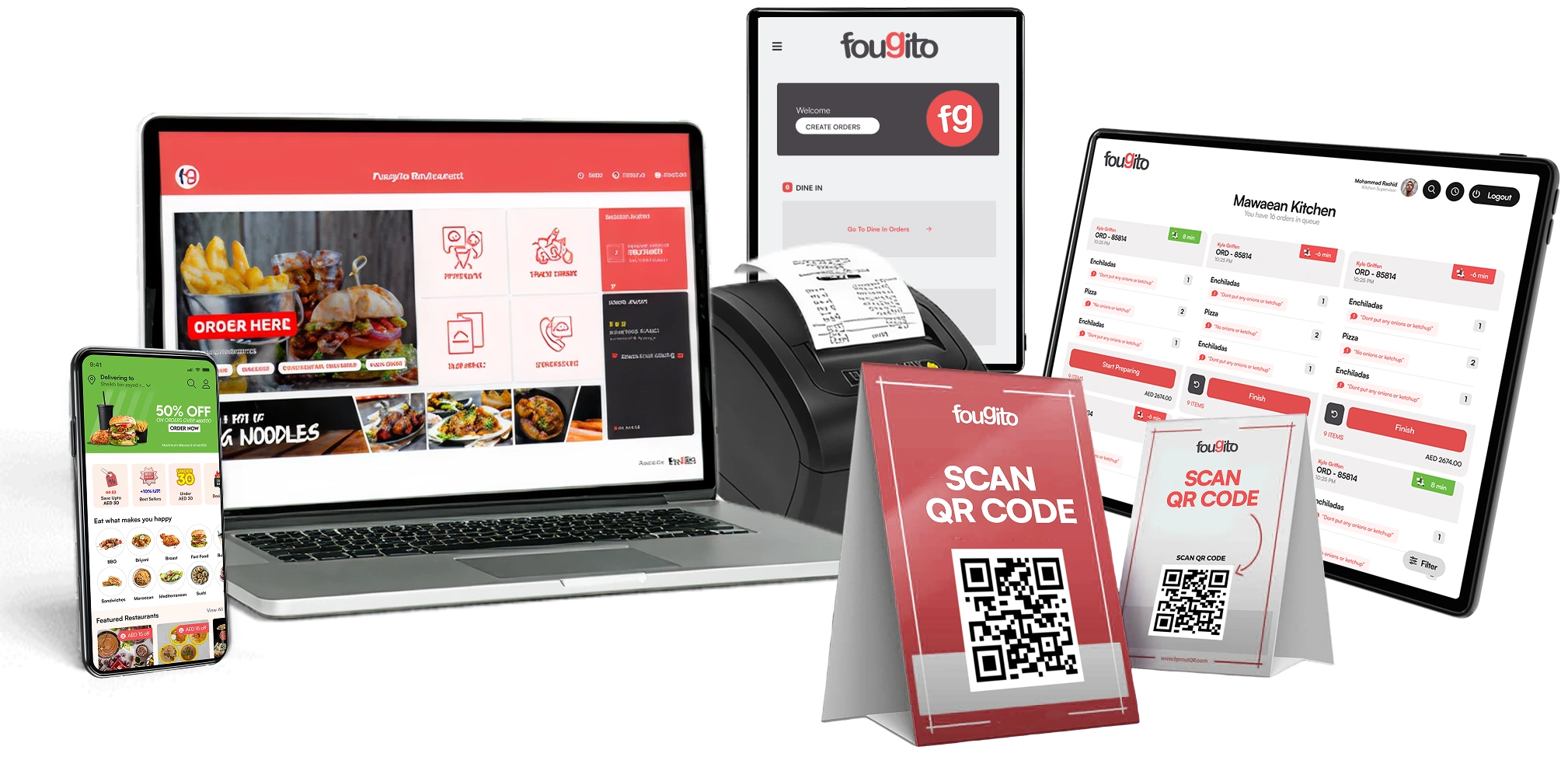
For example, Fougito's food platform can help restaurants reach customers who are exploring food options in Dubai. This can give restaurants another channel to showcase their menu and promotions to potential diners.
New customers are important, but your regular customers should not be ignored.
A customer who has already ordered from you knows your food and may be easier to bring back than someone who has never heard of your restaurant.
You can use loyalty rewards, personalised offers, birthday promotions, or simple messages to keep your restaurant fresh in their minds.
The important thing is to avoid sending the same offer to everyone all the time. A customer who orders breakfast every weekend may respond better to a breakfast deal than an offer for a late-night meal.
That is where customer data can make restaurant marketing more useful. Instead of guessing what people want, you can look at what they have actually ordered and build your next promotion around those patterns.

Planning a promotion is only half the job. You also need to know what can go wrong.
A promotion may look exciting on paper, but if the offer is too expensive, difficult to understand, or impossible to track, it can create more problems than sales. This is especially important for restaurants that are working with tight margins and need every campaign to have a clear purpose.
Here are three common mistakes to avoid when running restaurant promotions.
It is easy to get excited when you see a big increase in orders during a promotion. But more orders do not always mean more profit.
This is why restaurant cost analysis should be part of your planning from the beginning.
For example, imagine you offer a buy-one-get-one-free deal on one of your most popular dishes. The offer may bring plenty of customers through the door, but if the food cost is already high, giving away another full meal could put pressure on your margins.
A better approach could be to create a bundle where the customer receives value while you still have room to make a reasonable profit.
You do not always need to cut your prices to make a promotion attractive.
Consider alternatives such as:
These types of restaurant offers can create a sense of value without requiring a deep discount across your entire menu.
The main question should always be: What will the customer get, and what will the restaurant gain?
If both sides benefit, your promotion has a much better chance of becoming a sustainable part of your restaurant marketing plan.
Have you ever seen a promotion and had to read the terms several times before understanding it?
That is exactly what you want to avoid.
Keep your message simple.
TInstead of writing:
Receive a 15% discount when purchasing two selected main courses, subject to availability and applicable during specific weekday periods excluding public holidays.
You could say:
Get 15% off selected mains every Monday from 4 PM to 7 PM.
The second version tells customers almost everything they need to know straight away.
Every promotion should clearly mention:
A simple offer is easier for customers to use and easier for your team to deliver.
One of the biggest mistakes a restaurant can make is launching a campaign and then never checking the results.
You need to know whether your restaurant promotions are actually doing what you expected.
Imagine you launch a 'Buy One, Get One Free' offer on a new menu item. Orders increase, so you assume the campaign was successful.
But what if most of those customers would have ordered from you anyway?
Or what if the promotion increased orders but reduced your average bill?
Without tracking the numbers, you cannot answer these questions.
Sales are important, but they are not the only thing you should measure.
Depending on your goal, keep an eye on:
You can also compare the promotion period with a similar period when no promotion was running.
For example, if Tuesday sales normally average AED 5,000 and your promotion brings them up to AED 6,500, that sounds positive. But you still need to account for the cost of the offer before deciding whether it was worth running.
This is where good restaurant reporting can help. Your POS and ordering data can give you a clearer view of what customers purchased and how the promotion affected your business.
Not every promotion will be a huge success, and that is okay.
Perhaps customers loved the free dessert but ignored the discounted main course. Maybe your weekday offer performed well while your weekend campaign did not. Or perhaps customers responded strongly to a social media post but did not use the actual offer.
These results give you something useful: information.
Use that information to improve your next campaign.
Over time, your promotion strategies for restaurants can become more focused because you are making decisions based on real customer behaviour instead of simply guessing what might work.
Successful restaurant promotions are not just about offering discounts. A good promotion should give customers a clear reason to visit while also making sense for your restaurant’s budget.
Before launching your next campaign, understand what your customers want, keep your restaurant offers simple, and track the results. Use those insights to improve future campaigns and make your restaurant marketing more effective.
With the right planning, creativity, and restaurant cost analysis, promotions can help you attract new customers, bring back existing ones, and grow your restaurant without putting unnecessary pressure on your profits.